
Updated August 2026: every single laser toy originally listed here had gone out of stock or been discontinued, so I rebuilt this whole list from scratch — all 8 picks below are new as of this update, spanning handheld pointers, fully automatic units, and a couple of multi-function toys that build a laser into a bigger play package.
Cats absolutely love to play and one of their favorite ways to play is to hunt.
Laser toys for cats are flat out one of the easiest and most engaging toys available to keep your cat entertained and in shape.
Below we'll take a look at some of the best options to choose from and discuss the overall safety of laser toys for your cats.
The Best Laser Toys For Cats
Best All-in-One Handheld
Rechargeable Cat Laser Pointer, 7 Adjustable Patterns/Modes
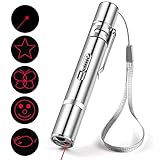
WNZQK's rechargeable pointer is the classic hands-on approach to laser play, and it's built to do a lot more than just point a red dot. Beyond the laser, you get a UV mode for checking stains around the house and a plain white flashlight, so it's not a single-purpose toy that only comes out during playtime.
It charges over USB through a removable back cover, meaning there's no fumbling for the right battery size when it eventually runs dry. It's compact enough to keep in a drawer or a pocket, ready whenever your cat wants a few minutes of chasing the dot around.
Best Backup-Ready Pair
Cat Laser Toy with Metal Case, 2 Pieces, 7 Adjustable Patterns

If one laser pointer isn't enough insurance against a dead battery at the worst possible moment, TBTeek's two-pack solves that outright. Both pointers ship together in a reusable metal tin, so one can sit charging while the other is already out doing its job.
Between the two, you get 7 total modes to play with — five laser patterns, a flashlight, and a UV mode for checking stains — split across a stainless-steel shell built to survive life in a junk drawer. It's an easy pick if you've got multiple cats, a multi-person household, or you just don't want playtime to grind to a halt because you forgot to charge it.
Most Genuinely Random Path
4th Generation Random Trajectory, Motion-Activated Laser Toy

The YVE LIFE laser toy is built entirely around solving the biggest complaint people have with automatic laser toys: predictability. Its dual-motor design genuinely randomizes the path instead of looping through the same handful of movements, so your cat can't just learn the pattern and tune it out.
A built-in motion sensor means it only kicks on when your cat actually wanders over, rather than running through a timer regardless of whether anyone's playing, and it powers back down on its own afterward. With 3 speed settings and both manual and automatic adjustment on the laser head, it's flexible enough to fit a range of play styles without you having to hover over it.
Most Efficient Automatic
Potaroma Smart Sensor Cat Laser Toy,

Potaroma takes a genuinely different approach with this one: instead of a laser head that physically spins or tilts to move the dot, it uses a mirror to reflect the beam into a truly random path — the listing describes this as roughly 80% more power-efficient than a typical motor-driven laser toy, since the laser itself never has to move. The dual-clamp mount is built specifically to resist getting knocked over, a common complaint with tower-style laser toys that just sit on the floor.
Motion sensing means it only fires up when your cat actually shows interest, running a short burst before shutting back down on its own, which makes it a solid pick for anyone who wants to leave it out during the workday. Both the tilt and the rotating base give you real control over exactly where the dot lands.
Best 2-in-1 Tabletop
ORSDA Cat Laser Toy, 2-in-1 Interactive Automatic Motion-Activated
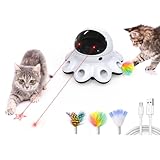
The ORSDA is a tabletop 2-in-1 unit that gives your cat two completely different games in one box: an automatic random-trajectory laser, and a whack-a-mole-style feather chase that pops up out of 8 spring-loaded holes. Rather than running both at once, the toy alternates between the two modes, so a session doesn't turn into the same repetitive laser loop every time you flip it on.
It's voice- and touch-activated on top of its own automatic cycle, and it also reacts to your cat's motion or sound, so it isn't purely running on a blind timer. Set it on a table, shelf, or the floor and it does the rest — no wall or window mount required.
Most Play Modes
MOHAYA Cat Toy, 4-in-1 Interactive with Laser

MOHAYA takes a broader approach than a single-function laser toy — this is a four-in-one unit built around a rotating mast, with the laser as just one of the play styles on offer. Alongside the laser, you get a fluttering butterfly-wand attachment noticeably bigger than most comparable toys, a peekaboo feather that pops randomly out of one of six holes around the base, and an LED-lit ball-track channel running along the bottom.
Reviewers specifically call out the laser feature as a household favorite among the toy's four built-in modes. It's a solid pick if your cat tends to get bored of any single toy fast and you'd rather rotate through a few play styles without buying four separate products.
Quietest Automatic
Saolife Laser Cat Toy, Truly Random Trajectory

Saolife built this one specifically to fix the thing longtime laser-toy owners tend to complain about most: predictable, looping patterns. The motor drives a genuinely random path through a flat-partition optical design meant to keep the dot crisp instead of smearing or dispersing as it moves, and reviewers who've cycled through other automatic laser toys before this one consistently call the randomness a real step up.
It mounts either with a suction cup to a window or just sits on a table or shelf, and it runs quietly enough that it won't spook a more skittish cat the way some louder motorized toys can. Between the adjustable head bracket and rotating base, you've got real say over where the beam actually lands.
Best for Multi-Cat Households
Automatic Motion-Activated, 5 Fun Patterns, 4 Speed Modes

TBTeek's automatic laser toy is a straightforward stationary unit built around a motion sensor, so it only fires up when your cat actually wanders into range rather than running blind on a fixed schedule. It cycles through 5 projection patterns and 4 speed settings, giving you more variety to work with than a lot of single-mode automatic toys, and the recommended 8-to-35-inch mounting range means it can work from a shelf, a low table, or the floor.
It's worth knowing upfront that this is a single-beam laser, not a dual-beam design — but that hasn't stopped it from working in multi-cat homes; one reviewer specifically describes using it successfully with three cats at the same time. If you've got more than one cat and don't want to buy multiple units, it's at least worth trying before assuming you need a dedicated multi-beam toy.
Additional Information
Laser Toy Frequent Q&A
There are two core types of laser toys available for our feline friends: the manual kind and the automatic kind. There's also a more unique overlap toy that has both manual capabilities and can be used in an auto mode too.
Manual laser toys are most commonly known as laser pointers. They're typically easily held in the hand, about half the length of a pen. They're considered manual because they require you to physically turn on the light, move it around, and stay engaged to entertain your cat. A few pros: they can move in very erratic, unpredictable patterns; they're dirt cheap, easy to use, and small enough to carry in your pocket; and you're fully in control of when it's on and off. The tradeoffs: you have to stay engaged to keep your cat engaged, and they're easy to lose since you often leave them in your pocket.
Automatic laser toys flip on and start displaying a laser dot on their own, with no hands-on involvement required. That's a real benefit for busy households — most come with an automatic timer that runs for 5, 10, 15, or 20 minutes, and they take the requirement of your time out of the equation. The tradeoff: most aren't as random as advertised, which can mean repetitive patterns and quicker boredom, and you generally have less control over exactly where the light ends up.
Cross-over toys bring the best of both worlds — an automatic mode that runs on its own, plus the option to pick the unit up and manually control it. The tradeoff there is usually size: because they're built to run automatically, they tend to be bulkier and less comfortable to hold than a dedicated pointer.
Here's how the 8 current picks break down:
- Manual pointers: #1 WNZQK, #2 TBTeek 2-Pack.
- Automatic units: #3 YVE LIFE, #4 Potaroma, #5 ORSDA, #6 MOHAYA, #7 Saolife, #8 TBTeek
- Motion-Activated. None of the 8 current picks are a true cross-over toy meant to be picked up and manually aimed like a pointer while also running on its own — but two of the automatic units (#3 YVE LIFE and #8 TBTeek Motion-Activated) include a manual override button that lets you kick off a play session immediately instead of waiting on the motion sensor, which gets you a little of that manual control without the toy being a true handheld. The Potaroma (#4) takes a different approach to the same idea — instead of a manual override button, it offers a separate timer mode you can set if you'd rather run it on a schedule than wait on motion detection.
Laser-based toys usually have a handful of key features worth taking into account:
Speed modes: The speed of a laser can determine whether or not your cat is willing to interact with it — too slow or too fast can be frustrating or boring. Since every cat is different, a model with multiple speeds (low, medium, high, and even random) is your best bet for finding what works.
Auto and manual use: Automatic toys are built to be hands-off, but getting your cat used to a new toy, or joining in on the fun yourself, usually benefits from an additional mode. Two of the automatic toys on this list — the YVE LIFE (#3) and TBTeek Motion-Activated (#8) — include a manual override button that lets you kick off a session immediately instead of waiting for the sensor. The Potaroma (#4) takes a different approach, offering a separate timer mode instead, so you can set it to run on a schedule rather than wait on motion detection.
Location of use: Any automatic toy needs somewhere to shine the light down onto the floor or play area, and it's worth considering how rambunctious your cats are when picking a spot. Among the current picks on this list, the Saolife (#7) mounts via suction cup to a window, the Potaroma (#4) clamps to a chair, door, or shelf, and the ORSDA (#5) is a stationary tabletop unit that doesn't need a mount or suction at all — you just set it down. None of the 8 current picks are designed to be permanently wall-mounted the way some laser toys used to be, so keep that in mind if an out-of-reach, ceiling- or wall-mounted setup is specifically what you're after.
Number of cats: The bulk of automated toys are designed to project one laser at a time, and that's true of every automatic pick on this list — none use a true dual-beam design. Single-laser models can still keep multiple cats entertained at once, either trading off on the hunt or watching together; reviewers on the TBTeek Motion-Activated (#8), for example, describe it working well across three cats at the same time. It's worth noting that with multiple cats sharing one laser, it can, in limited cases, cause squabbling over the dot — something to watch for regardless of which laser toy you choose.
Shape of the laser: Some laser pointers come with attachments that turn the dot into a mouse, butterfly, or bug shape. Mostly, this just makes it seem like your cat is chasing something different — it doesn't make much difference to the cat itself, since they're mostly after the light, not its shape. I'd generally recommend sticking with the standard dot attachment; it keeps the light brighter and more centralized so your cat can track it more easily.
The biggest concern most owners have with laser pointers is whether the laser is dangerous near a cat's eyes. The short of it is that with a manual laser pointer, you simply want to avoid pointing it directly at your own eyes or your cat's eyes. Shining it near your cat's eyes for a split second shouldn't cause any harm, but do your best to avoid your cat's face entirely.
You can also look for a listing that specifically calls out a "Class I" laser rating (IEC/FDA pet-safety certified) — several of the picks on this list, including the WNZQK (#1), YVE LIFE (#3), ORSDA (#5), and Saolife (#7), are rated this way. It's worth noting that pretty much any commercially available laser sold for pet use is safe so long as it isn't shone directly into the eyes for any extended period of time.
The biggest safety problem for cats with laser pointers has nothing to do with the laser itself and everything to do with the way they interact with it. When cats go after the red dot, they're basically hunting — they stalk, they pounce, they expect to end up capturing something at the end of it. But with a laser pointer, they never capture anything. Ever.
When a cat constantly plays and ends up catching nothing, it can end up being very frustrating and stressful for a small minority of cats. Dr. Marty Becker from Vetstreet calls this the "never win the game" problem. Most cats have no issues winding down from a play-hunting session, but those that do can actually have significant side effects from laser-based toys — stress-based over-grooming is by far one of the most common results.
The good news: there's an easy way to deal with this if you recognize it in your cat. Simply have multiple toys handy during your play session. You can start off with a laser-based toy and then switch to a wand toy or anything else your cat absolutely loves. You can even use the laser pointer to point at a wand or another toy, so your cat lands on and "kills" something in their hunting session. This gets you all the benefits of the laser and the engagement it brings, without your cat developing stress or anxiety over never being able to actually catch anything.
It comes up on nearly every automatic pick in this roundup, so it's worth addressing head-on rather than letting it sit buried in each individual write-up. The YVE LIFE (#3), Potaroma (#4), ORSDA (#5), MOHAYA (#6), Saolife (#7), and TBTeek Motion-Activated (#8) all draw a similar split in their reviews: plenty of owners report a single charge lasting several days to a week of regular use, and units holding up for months without issue, while a meaningful minority on each of those same listings report a battery that drains faster than expected, a motion sensor that stops triggering reliably, or a unit that stops working entirely within the first month or two.
This looks like a pattern across the automatic-laser-toy category broadly, not a defect specific to any one of these picks — inexpensive rechargeable electronics with a moving or sensing component just have a wider quality-control spread than something with no moving parts at all. If a toy stops responding, it's worth trying a full charge cycle before assuming it's a lost cause, and running any new unit through a few real play sessions early on is a reasonable way to catch a problem while you can still act on it.
Not necessarily. Wall- or window-mounted laser toys became popular because they solve one specific problem — a cat repeatedly knocking a floor-standing unit over during play — but they're not the only way to solve it. Several of the current picks on this list solve the same problem differently: the Potaroma (#4) uses a dual-clamp mount that secures to a chair, door, or shelf; the Saolife (#7) uses a suction cup that sticks to a window or any smooth surface; and the ORSDA (#5) is a stationary tabletop unit that doesn't need a mount or suction at all — you just set it down.
None of the 8 current picks are built to be permanently mounted to a wall the way some older laser toys were, so if that specific out-of-reach, ceiling-style setup is a hard requirement for your household, it's worth checking a listing's mounting options closely before you buy. For most homes, though, a clamp, a suction cup, or a stable tabletop base gets you the same knock-over protection without needing to drill or stick anything to a wall.
You may wonder why cats go absolutely bonkers for laser toys and it is a fair question. For a period of time back in the 90s kids went nuts for them when they were shone on movie screens, but after that they really weren't that exciting.
It comes down to instinct, not the color or the "toy" itself. Cats are hardwired hunters, and a small, fast, erratically moving point of light hits every trigger a real target would — mice, bugs, and other prey move in that same quick, darting way, and a cat's brain doesn't really distinguish "laser dot" from "something small and alive that just moved." That's why you'll see the full hunting sequence show up during a laser session: the low crouch, the stalking creep, the tail twitch, then the pounce. None of that is trained behavior — it's the same stalk-and-chase wiring an outdoor cat would use on an actual mouse, just aimed at a dot on your living room floor instead.
This instinct doesn't fade just because a cat is well-fed and living entirely indoors. The drive to chase something small and fast-moving sticks around regardless of whether your cat has ever hunted a day in its life, which is a big part of why laser toys work so reliably across basically every cat, from a barely weaned kitten to an older indoor-only cat who's never seen a real bug indoors. The dot's small size and unpredictable movement are actually doing most of the work here — a laser mimics prey far better than a larger, slower-moving toy would.
For a fun visual on all this playing out in real time, take a look at the video embedded right below this section.
Wrap Up
Laser and light based toys are great options for cats, especially those with extremely high prey drives. They not only are easy to use, but these days there are a ton of automated options you can consider toy. That being said, I still think the best laser toys for cats are your traditional hand held manual laser pointers.
If you have any questions or would like to leave your own thoughts about laser pointers please add a comment below! Thanks for reading.
StuffCatsWant.com is a participant in the Amazon Services LLC Associates Program, an affiliate advertising program designed to provide a means for sites to earn advertising fees by advertising and linking to Amazon.com.
