
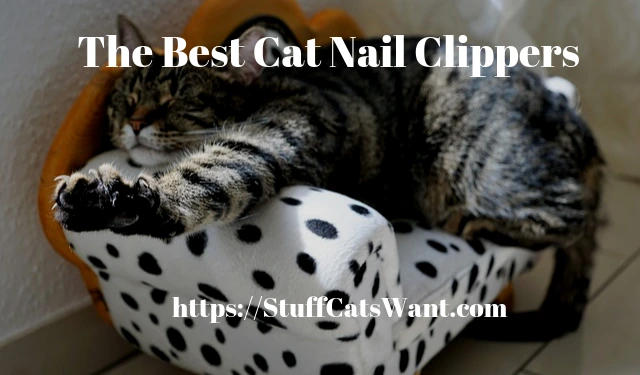
Cats scratch things. It is instinctual. You can either have a cat that scratches or you should probably not have a cat. But proper cat nail care will both decrease the damage caused by scratching and minimize the amount your cat scratches.
To properly care for your cat’s nails you’re going to need clippers. There are several different kinds and a laundry list of manufacturers out there. This article will show you the best cat nail clippers available and why to use one versus another.
Updated October 2026: I've gone back through this whole list to keep the picks and details current.
Best Overall
Pet Republique Professional Cat Nail Clippers
These clippers are designed for small breeds, meaning kittens, cats, and small dogs, and they also work for birds. Reviewers repeatedly compare trimming their cat's nails with them to trimming their own nails: quick, simple, and unremarkable in the best possible way.
The blades are thick stainless steel, and the handles are non-slip. If you only try one pair of clippers off this whole list, this is the one I'd point you toward first.
Guillotine Option
Resco Professional Guillotine Cat Nail Clippers
Resco's original guillotine design has been made in the USA since 1937. This is the cat version, shaped for cats and tiny pets so it contours around small nails.
Instead of snipping like scissors, you slip the nail through a ring and a blade slides across to make the cut. If you like the idea of swapping a blade instead of replacing the whole clipper, this is the style for you.
Need a replacement blade? Resco's Pro Pack fits every Resco guillotine-style clipper, this one included. The listing title says "dog," but it's a universal blade pack. It includes 6 hand-sharpened American steel blades, a change pin, and a wooden test dowel, and it's backed by a lifetime warranty on manufacturing defects. A few have noted blades arriving dull or fitting poorly, so test a new blade before assuming the fix worked.
Japanese Steel Option
Necoichi Purrcision Cat Nail Clipper
Necoichi is a cat-only brand, and the Purrcision is its scissor-style clipper. Reviewers say the blades feel noticeably sharper than what they used before, and that they cut cleanly without tearing or splitting.
Trims are quick, and cats seem to tolerate it. Owners also call it durable and worth the money.
Best for Multi Pet With Cats
gonicc Pet Nail Clippers for Cats & Small Animals
This gonicc pick is designed for cats, small dogs, kittens, birds, and bunnies. A semi-circular angled blade keeps your view of the nail clear while you cut rather than blocking it.
The hypoallergenic stainless steel blade and slip-proof handle coating round out the build. Reviewers consistently describe it as effective, professional-quality, and good value. It's a straightforward, no-frills option if your household is all small pets.
Best For First Timers
Shiny Pet Cat Nail Clippers
Shiny Pet brings a well-rounded set of cat nail clippers to the table, and it's an especially good option for your first-ever trim. It's built for indoor cats, kittens, small dogs, rabbits, and birds. The razor-sharp stainless steel blades pair with an ergonomic anti-slip handle coating that keeps your grip steady.
What sets it apart is what's included: an instructional eBook plus a companion "Happy Paws Tracker" app, so you're not guessing your way through those first few trims. It's backed by a lifetime warranty too, which is a nice bit of reassurance for a first purchase. For extra how-to help, you can also read my post on how to clip your cat's nails.
Best for Seeing the Quick
PAKEWAY Cat Nail Clipper with LED Light
PAKEWAY is a scissor-style cat clipper with an LED at the tip that lights the nail so the quick is easier to spot. The listing is titled and categorized for cats and kittens, and it also lists rabbits, guinea pigs, and small dogs.
Reviewers call it a top pick for cat nails and say it's easy to use, especially on kittens. There's also a UV light, which the listing says can reveal skin issues such as ringworm. That's a listing claim, so see your vet about any real skin concern.
Best for Precise Trims
JW Pet GripSoft Cat Nail Clippers
JW Pet's GripSoft clippers are scissor-style, with a short length designed for precise, controlled trims. The non-slip rubber handle keeps things steady while you work. The "one size fits all" design is meant to suit every cat breed and age, kittens included.
Reviewers consistently call it one of the better small clippers for cats and small dogs, praising how easy it is to handle and how sharp and effective the cut is. It's a solid, no-frills pick if you want precision over anything fancier.
Best Built-In Guard
PETHROOM Cat Nail Clipper, 2mm Circular Cut Hole
PETHROOM is built for indoor cats and works on a simple idea. The nail goes through a small circular hole, and only the tip sticking out beyond the hole gets cut. That hole acts as a built-in guard.
Reviewers say cats tolerate it calmly and that it gives nervous owners more confidence. They also describe it as easy to use, fast, and good value.
Best Ambidextrous Option
Whisker Wishes Veterinarian Grade Cat Nail Clippers
Whisker Wishes' Veterinarian Grade clippers have an ambidextrous handle that works comfortably whether you're right- or left-handed. High-quality stainless steel blades deliver clean, rust-free cuts.
The grip is designed to hold firm even if your cat squirms mid-trim. Reviewers consistently describe it as effective on both cats and small dogs, with a comfortable, easy-to-handle feel.
Best Electric Model
Dremel 7350-PET 4V Pet Nail Grinder
If manual clippers just aren't working for you or your cat, the Dremel is worth a look. It's a grinder, not a clipper. Instead of one decisive snip, it slowly grinds the nail down. One honest note up front: this is a dog-first tool.
The listing is titled for dogs and cats and says it works as a cat grinder, but the owner feedback is about dogs. It's a single-speed, cordless tool, powered by a USB-rechargeable 4V lithium battery rather than disposables.
You'll also want to keep in mind that it's much louder than any form of manual clippers. If your cat doesn't like loud noises, it isn't going to go over well unless you spend adequate time acclimating them first.
Additional Information
Frequently Asked Cat Nail Clipper Q&A
I have written a comprehensive post on this topic right here. Be sure to check it out if you have any general how-to questions. You can also check out the video below, which is an excellent resource with a veterinarian teaching you how to clip a cat's nails.
There are three major types of nail clippers on the market for cats. You'll want to select your option based on the age of your cat and the frequency with which you plan to clip their nails:
- Guillotine clippers: Similar to the actual guillotine, these use an entry slot for the nail, and when you squeeze the handles together it drives a single sharp blade forward to cut the nail.
- Pros: They provide a really clean cut, especially when the blade is sharp. You can easily buy replacement blades and drop them in yourself.
- Cons: It can be tough to get the nail into the slot.
- Scissor clippers: They look just like scissors, pretty straightforward. You can get them in various sizes — smaller clippers for smaller/younger cats, larger ones for bigger or older cats that get trimmed less often.
- Pros: It's far easier to get a nail into scissor clippers than guillotine ones; they're easier to maneuver.
- Cons: If you don't squeeze firmly and quickly, there's more chance you won't get a clean cut. Getting them sharpened is difficult — you usually just buy a new set once they dull.
- General multi-pet clippers: These will handle a cat's nails just fine, but they aren't specifically designed for cats. They tend to look similar to pruning shears and run a little more heavy-duty, since they're built to also handle dog nails.
- Pros: A single model works across multiple pets (dogs/cats/birds/etc.).
- Cons: They can be a little large and bulky for cat nails specifically.
I personally use scissor clippers for both of my cats, usually while someone else holds them, which makes it easier no matter which type you land on.
Here's how the ten picks on this list break down by type:
- Guillotine-style: #2 Resco.
- Scissor-style: #1 Pet Republique, #4 gonicc (Cats & Small Animals), and #9 Whisker Wishes, #3 Necoichi, #6 PAKEWAY (with an LED light), and #7 JW Pet GripSoft.
- Circular-hole guard design: #8 PETHROOM, where the nail goes through a small hole and only the tip beyond it is cut.
- Electric/rotary grinder, a different category entirely: #10 Dremel 7350-PET.
- Includes an instructional eBook and app for first-timers: #5 Shiny Pet.
My experience is that if your cat is pretty religious about scratching to sharpen their nails, you'll probably need to trim them about every two weeks or so. If you wait much longer than two weeks, you'll start to see your cat's nails turn into talon-like razor blades.
When your cat is younger, especially kitten-aged, I'd highly recommend trimming even more often — once a week followed by treats is a great way to build a positive experience around trimming quickly.
You might even want to consider only trimming one paw at a time over a few days while your cat is young, rewarding them with treats each time. The positive reinforcement works wonders with cats.
The frequency answer above touches lightly on this, but the more often you trim your cat's nails, the more likely they are to get used to it. I highly recommend starting young if you adopt a kitten — trim often and reward often.
If you've already got an adult cat that dislikes or doesn't tolerate trimming well, a few options are worth exploring:
- First and foremost, get your cat familiar with the clippers so they aren't simply afraid when they see them. Leave the clippers somewhere your cat frequents — their bed or a spot she sleeps often is ideal. This means the clippers will pick up her scent and she'll be familiar with their sight, associating them with something she likes (sleeping).
- This step may sound silly, but it works: develop familiarity with the sound of clipping. Your cat often can't see what you're doing while you clip, and new sounds can be frightening. Cutting pieces of raw, uncooked spaghetti near your cat while she's doing something she enjoys can help associate the sound with a positive experience.
- Last but not least, gradually trim nails if your cat is already afraid or dislikes it. You might only trim one paw at a time, or trim just a couple of nails before letting your cat scamper off and rewarding with treats.

This can be a very gradual process. Give yourself time and stay dedicated to it. Most cats will never enjoy having their nails trimmed, but tolerating it without scratching or biting you is a huge step in the right direction.
Yes, you should definitely clip your kitten's nails. When your cat is young is the best time to teach them new things about life — not only are they far more impressionable at this age, they're also far easier to handle given their size.
This gives you multiple advantages over the long term. The sooner you start educating your kitten on the process, the sooner they'll get used to it and let it happen with minimal complaint.
One thing worth considering: kitten nails are much, much smaller than their adult counterparts, so traditional clippers may not be the right choice. A good, high-quality set of human nail clippers can work well while your kitten is young. Just never use human clippers on an adult cat — they aren't designed to cut through a nail that thick, and could easily "shatter" it instead of clipping it, which is very painful for your cat.
Fit comes up in two different ways on this list, and it helps to separate them. The first is fit to your cat's nails. Shiny Pet (#5) and Whisker Wishes (#9) each draw a minority complaint that they run a touch large for very small or kitten-sized cats. PETHROOM (#8) has a small circular hole, so thick or large back claws sometimes don't fit well. PAKEWAY's light (#6) is also less helpful on the claws of very large cats.
The second is fit to your hand. JW Pet GripSoft (#7) has finger holes that run small, which suits smaller hands better. Some owners find PAKEWAY (#6) snug in the finger holes, and a few find PETHROOM's fully open handle wide for small hands.
None of this makes these picks bad. It just means the size chart and listing photos are worth a close look before you order. If you have a very small cat or a kitten, start with the picks that list kittens, tiny pets, or small breeds among who they're for. Those are Pet Republique (#1), Resco's cat clipper (#2), gonicc for Cats & Small Animals (#4), and JW Pet GripSoft (#7). If your cat is very large with thick claws, double-check PETHROOM (#8) and PAKEWAY (#6) first.
The quick is the part of the nail that has numerous nerve endings and pumps blood into the nail. You can see it if you look closely, since it's a clearly different color from the rest of your cat's nail. It's genuinely painful to cut and can bleed quite a bit, so you have to be extra careful and only trim the clear, dead part of the nail beyond it.
If you do happen to mistakenly cut the quick, your cat's nail will bleed pretty much immediately. I highly recommend keeping a styptic powder or gel nearby — it'll help you quickly stop the bleeding. I'd also recommend immediately stopping the clipping session and picking it back up another time.

Recommended styptic powder: Miracle Care Kwik Stop Styptic Powder. It's a fast-acting formula with benzocaine for pain relief, and reviewers widely describe it as a must-have pet first-aid staple for exactly this situation. A handful of reviewers have reported the container arriving with a lid that wasn't fully sealed, so give it a check as soon as it arrives rather than assuming it's fine.
Dress smart for clipping your cat's nails. You don't need anything terribly unique, but long sleeves and a couple of layers definitely help — skip the t-shirt or spaghetti-strap shirt. This gives you a bit of a buffer if your cat's claws do come out mid-trim.
I personally wear a hoodie and jeans, and I like to put a small blanket in my lap when we clip Lexi and Beast's nails. If you're working with a cat that's extremely unhappy about the whole process, pot mitts or even farm-style protective gloves are worth considering.
If you've read anywhere that declawing your cat is a viable alternative, that's incorrect — declawing is incredibly inhumane and can cause your cat numerous health and behavioral problems over the long haul.
If you're uncomfortable or unable to clip your cat's nails yourself, a few things are worth considering instead:
- Groomers: A trip to the groomer is another way to get your cat's nails trimmed. Admittedly, if they don't like you clipping their nails, they probably won't be thrilled about the groomer either — but if you're already taking them in for a haircut or a trim, the groomer can handle their nails too.
- Scratching surfaces: Cats need to scratch something, and it's best to provide surfaces designed for it. Otherwise they're likely to scratch up things you don't want them to (like your couch). Providing numerous surfaces in areas they frequent lets them constantly shed the outer layers of their nails. If you're not sure where to start, our roundup of the best sisal cat scratchers is a good place to look:
- Your veterinarian: Most vet offices will provide a free clipping (and sometimes a bit of a trim) if you ask at the end of a visit — a nice, easy way to get a quick trim done by a team that handles cats all day, every day. Be careful though and ask if it is free, otherwise sometimes you'll get charged $20 bucks for a little buzz cut or a few trimmed nails.
Wrapping It Up On the Best Cat Nail Clippers
Clipping your cat's nails should be a part of your normal care routine for your feline friend. There are a wide variety of options available when it comes to the clippers you put to use, but no matter what you use you should ensure they are always sharp.
Sharp clippers make sure that when you clip you'll have nice clean cuts that are unlikely to damage your cat's nails so that you both have the best experience throughout the whole situation.
If you're unable to clip your cat's nails, be sure there are plenty of good scratching surfaces available and consider an alternative like taking your cat to a groomer or asking your veterinarian to perform a clipping during each visit (most do it for free!). You shouldn't let your cat go without clipping for too long, as it can start to make it tough for them to walk.
Whichever option you choose, definitely leave a note in the comments below to tell us how it worked out for you!
StuffCatsWant.com is a participant in the Amazon Services LLC Associates Program, an affiliate advertising program designed to provide a means for sites to earn advertising fees by advertising and linking to Amazon.com.
References:ASPCA, Humane Society, Resco Pet Products
