
This post was updated in July of 2026 to reflect the latest options!
'So you’re in the market for cat carrier and you want to make sure you get one that is just right for your cat. Given there are about a million options on the market you'll want to choose one of the best cat carriers around.
Below there's a list of some of the best carriers around and then a bunch of additional info on carrier selection and why you might need one. So get to reading, pop open the Table of Contents for easy navigation!
If you're specifically looking for a Cat Bubble Backpack check out this article.
The Best Budget Carrier
The Amazon Basics Soft Sided Carrier

If your carrier's only job is getting your cat to the vet and back a couple of times a year, you don't need to overspend on it. The Amazon Basics Soft Sided Carrier is about as no-frills as carriers get, but it covers the basics well and won't dent your wallet doing it.
It comes in two sizes, so measure your cat before you order instead of guessing — a carrier that's too snug defeats the whole purpose. I wouldn't reach for this one for a cross-country flight, but for routine trips, it's genuinely hard to beat.
A couple items worth noting on this one:
A few things worth cautioning you about:
The Most Extra Room
The PetsFit Expandable Travel Carrier

If you’re looking for a soft carrier that is a hefty chunk larger and has more comfort than something like the Amazon Basics carrier than the Petsfit Expandable is a great carrier to consider. Not only does it include all the major perks of the Basics carrier, but it also has some cool features like the expandable side area that gives your cat a big bump up in real estate space inside.
This is exceptionally useful when you have a long layover or a long trip in a car and you don’t want to let your cat out, but still want her to have some space for comfort or a bowl of water or food. There’s a full video review available below, but the bullets below detail it out pretty well:
A few things worth cautioning you about:
The Shelter Standard
The Petmate Two Door Top Loader

Petmate is an incredibly well known company and I see these carriers in use on a consistent basis at the shelter I volunteer at all the time. Not only are they well designed, but they are incredibly durable and they come in a varying set of sizes.
I’d highly recommend you go with the 24 inch version for any adult cat and if you have an extra large cat you might want to consider something even bigger than this. That being said, these carriers are constructed solidly and perform extremely well. You can also check out the video review below.
Key features worth noting:
A few things worth cautioning you about:
Best Hands Free option
Petsfit Comfort Cat Backpack

If you've ever tried to walk any real distance with a cat carrier digging into one shoulder, you already understand the appeal of a backpack. The Petsfit Comfort Cat Backpack puts the weight on both shoulders instead of one, which makes a real difference over any kind of distance.
It's built for cats 15 pounds and under — I'd stick close to that ceiling, since anything bigger starts to feel genuinely cramped inside. It's a great option if you're the type walking your cat somewhere on a regular basis rather than just driving them to the vet twice a year.
A few items worth cautioning you about:
Best for Senior Cats
ZENY Foldable Pet Stroller

The original stroller pick in this spot for years was the Paws & Pals City Walk, which was genuinely the most popular pet stroller I'd come across — a favorite for older cats getting safe outdoor air, and for bonded pairs of cats who'd rather ride together than get split into separate carriers.
That exact listing has gone out of stock, so we're pointing you toward the ZENY Foldable Pet Stroller instead, which keeps the same core idea: four wheels, an enclosed and ventilated riding area, and none of the weight resting on your arms or shoulders.
It's a genuinely different category from a traditional carrier, worth considering if you're regularly taking a senior cat, a nervous cat, or two cats out together rather than just to the vet.
Cautions:
Best Two Kitten Carrier
Bejibear Cat Carrier for 2 Kittens

The old Pet Magasin Collapsible carrier that used to hold this spot combined a firm hard-sided frame with the fold-flat convenience of a soft carrier — a nice combination, but that exact listing is gone now.
The Bejibear Large Cat Carrier for 2 Cats fills the gap with a different angle worth considering if you've got more than one cat: it's sized generously enough for two, still collapsible for storage, and built to TSA's airline-approved dimensions.
If you've been stuffing two kittens into a carrier meant for one, or splitting them into two separate bags they hate being apart in, this is the kind of upgrade worth a look.
Best for Anxious Cats
"You've got This" Cat Carrier

The "You've got This" Cat Carrier has a focus on just being a genuinely good carrier for an anxious cat. It leans hard into reducing travel stress specifically, with privacy flaps and a top-load design that doesn't require wrestling a scared cat in through a front door they can see coming. If your cat turns into a puddle of anxiety the second the carrier comes out of the closet, this is built with exactly that cat in mind.
Cautions:
Best Panoramic Views
PetLuv Premium Travel Carrier

Some cats handle travel fine. Others turn every car ride into a full meltdown, and if yours is the second kind, the PetLuv Premium Travel Carrier is built with exactly that cat in mind.
The roomy design and all-around windows mean your cat isn't stuck staring at a wall of fabric the whole ride, and there are enough anxiety-focused touches here that it's clearly designed by people who've dealt with a stressed-out cat before. It runs a little larger and pricier than the basics, but if travel stress is the actual problem you're solving for, it's worth the upgrade.
A few items worth noting on this model:
Best Rolling Carrier
Petsfit Rolling Cat Carrier w/ Removable Wheels

If you're tired of a shoulder strap digging in, or your cat's simply too heavy to comfortably carry very far, the Petsfit Rolling Cat Carrier solves that by letting you pull instead of carry. It functions basically like a small rolling suitcase, and the wheels pop off entirely if you need to store it flat or just want the option to carry it by hand for a stretch.
It's rated to hold pets up to 28 pounds, which covers most cats with plenty of margin, but measure your own cat rather than assuming. One important note up front: this is not an airline-approved carrier, so if you're flying, look elsewhere on this list rather than at this one.
A few things worth noting for you potential buyers:
Best Airline-Approved Expandable
Airline Approved 4-Sider Expandable
The Jet Sitter that used to hold this spot built its whole reputation on fitting under a United Airlines seat, and I get why that mattered — I've flown cross-country with my own cats on United more than once, and the carrier you bring genuinely makes or breaks how smooth that day goes.
That exact listing has since gone dead, so we didn't want to just drop the category along with it. This Airline Approved Pet Carrier steps into the same role: TSA-compliant, sized to work under most major airline seats, and expandable on four sides once you're off the plane. If air travel with your cat is genuinely why you're shopping right now, this is one of the stronger picks on this whole list for that specific job
There is one major item worth cautioning you about with this model:
Best Budget Airline Pick
TSA Approved Soft-Sided Carrier
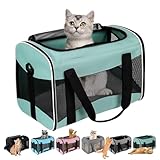
The old Pet Magasin Luxury TSA carrier was a small, lightweight option built to squeeze under nearly any airline seat, and its replacement keeps that same job description. This soft-sided carrier is TSA and airline-approved, rated up to 16 pounds, and collapses flat when you're not using it, all at one of the lowest price points on this entire list.
It's not built for long-haul comfort or a giant cat, but if you need a straightforward, budget-friendly carrier that'll actually get you and your cat through security without a hassle, this covers it.
A couple of things to consider before your make your purchase:
Best Easy-Load Hard Carrier
SportPet Hard Sided Triangle Traveler

If you like the security of a hard-sided carrier but you're worried about your cat being stressed out climbing into a tight opening, the SportPet Triangle Traveler solves that with a genuinely huge entrance.
It's the kind of carrier your cat can practically walk right into on their own, rather than something you have to wrestle them through. It's built for trips to the vet, around town, or even a longer car or train trip, and solid plastic construction means cleanup is about as easy as it gets.
It's not built for air travel, but for everything else, it's a strong, no-nonsense hard carrier.
A couple of items worth considering before purchase:
Best Extra Legroom
Two Sided Expandable Soft Carrier

If your cat's the type who wants to actually move around once you're settled in rather than stay balled up for the whole trip, this is the carrier built for that. It's airline-sized to clear TSA and most under-seat requirements while collapsed, but pop both the front and back panels out once you're through security or off the plane and your cat suddenly has a lot more room to stretch, turn around, and stake out a spot.
Four separate entry points also mean you're not stuck coaxing a stubborn cat in from one single opening — top, either side, or the front all work. It earns this label specifically because it's one of the few picks on this list giving your cat real extra square footage without giving up airline compliance to do it.
Worth cautioning you about before purchasing:
Best for Big Cats
Sivlefoss Large Cat Carrier

For big cats, I'm recommending the Sivlefoss Large Cat Carrier, which covers the same "big cat" need but takes a completely different approach: instead of a rigid hard-sided kennel, it's a soft-sided, collapsible fabric crate in the same 24-inch size class, built with a plush mat included for comfort.
If you've got a larger cat and you liked the old pick's size range but not necessarily its hard-sided bulk, this is worth a look as a lighter, more packable alternative.
A few things worth cautioning you about:
Best Outdoor Lounging Setup
Portable 2-in-1 Double Pet Kennel

This portable 2-in-1 double kennel/shelter gives your cats two separate compartments they can share or keep apart, with a seat-belt fixture built in for securing it during car travel. It's not something you'll be carrying long distances by hand, but as a home-away-from-home setup for outdoor time or road trips, it fills a real niche the rest of this list doesn't cover.
Cautions:
Additional Information
Frequent Q&A
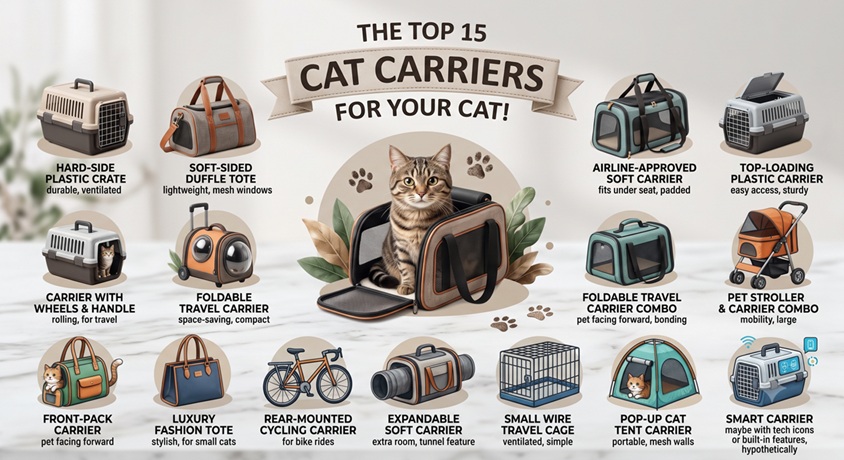
There are several different kinds of carriers on the market and each one has perks and drawbacks. Below I’ve given a high level description of each of the major types. Further down you’ll find a high level comparison of the major benefits of each different type of carrier and the potential shortcomings as well.
Cardboard Carriers:
The most common place you’ll find a cardboard carrier is at an adoption center or an animal shelter. Cardboard carriers are meant to be a very temporary solution to get your cat from the adoption center to your home. This should definitely not be considered a permanent solution for a laundry list of reasons, but the biggest two are that cardboard carriers are flimsy and they aren’t comfortable to hold.
One additional item to consider is that they don’t provide a great deal of ventilation which is key for any carrier and you can’t simply open a small portion of the carrier because the whole top is the only entry/exit point. To reiterate, you should only use this in unique circumstances.
Hard Carriers:
Hard carriers are probably the most common carrier around. They are generally made of a combination of plastic and metal. The frame itself is usually plastic with the door being made of a lightweight metal. Hard carriers are very firm and provide a nice secure surface/place for your cat to travel.
The biggest concern with hard carriers is that they aren’t very comfortable to travel with (for the human!), even short distances. They typically have one big handle on the top and that is the only way to hold or move the carrier. This can make them irritating if you have to move your cat a long distance because hard carriers are typically heavier and they’ll be banging against your hips or legs with every step. One other thing that always freaks me out from a safety standpoint is I worry the handle will give and rip the top off letting the cat out while I’m outside.
Soft Sided Carriers:
Soft sided carriers are probably the second most common type of carriers, hard plastic carriers being the most common. Soft sided carriers are traditionally made of nylon or some derivation of it which makes them flexible and lightweight. They also usually have a solid set of short straps for easy carrying directly in your hand, but more importantly they have a larger and longer shoulder strap to let the weight rest instead of actively having to hold it up. This means they are a heck of a lot easier for you as an owner to carry around.
Generally soft sided carriers are comfortable for cats as well because they come with in included pad or piece of lambswool to stick inside on the bottom. Soft sided carriers come with all sorts of other features to make them better for different kinds of travel, for example the one on the left has fold down covers for the vents so you can help minimize outside sensory overload for your cat at stressful times.
There are also soft carriers that have cool features like pop out sides to expand the size of the carrier when it is stationary. They are also great for storage purposes because they break down easily, many completely collapse in on themselves into a flat pancake style setup.
Soft carriers aren’t perfect by any means though. One key thing to keep in mind is that since they aren’t made of firm materials they can leave your cat to bounce around/dip up and down quite a bit as you move which might result in an unhappy cat or a motion sick cat. Be sure to check how firm the bottom is before purchase.
Backpack Carriers:
Backpack carriers are definitely somewhat of a novelty in the market right now, they are a variation on soft sided carriers. You can find all different sorts of them from ones that have a single bubble window on the back so your cat can see out to full on ‘soft style’ carriers with backpack straps so you can more easily hold your cat and walk around with them. If you have trouble with the standard single shoulder strap on the soft carrier this might be a good option for you to consider, but be sure to get one with good ventilation.
Check out our full roundup of backpack carriers here.
Another common use for backpack style carriers is for adventure cats. Adventure cats are those types of cats that are commonly out in the open following their owner around on foot during hikes and walks (usually on a harness/leash). The backpack carrier is a great spot to deposit your feline friend if a less than ideal situation appears that could endanger your kitty.
Suitcase/Stroller Carriers:
Rolling carriers are generally another variation on soft sided carriers, on wheels. Rolling carriers were developed for folks that have difficulty carrying heavy objects around. Given that some of our cats these days are getting in the area of 20 lbs or more (I’m looking at you Maine Coon owners!) they can be pretty tough to lug around on a single shoulder strip. Rolling carriers tend to be a bit larger than a traditional soft carrier and they also take away the strain of carrying the cat yourself by laying all the weight on the wheels just like a rolling suitcase.
My biggest gripe with these kinds of carriers is that the wheels are often tiny so they get stuck easily on pavement. On top of this the wheels are often made of plastic instead of rubber to keep things cheaper and this makes a ton of noise when you roll it. Most cats aren’t a fan of being in the carrier to begin with, loud noises don’t help with keeping them calm.
There’s no single right answer to this question. The right carrier for you and your furry friend is going to be different than the one I choose. We all have different priorities and different cats too. I live downtown and I walk my cats to the vet, but other than that they hardly leave the house. This leads me to use a soft sided carrier because it is easy to throw the single strap over my shoulder and walk, but it also breaks down super easily and can be stowed away in my closet.
You might on the other hand need a carrier that fits a much larger cat that mine and your kitty might be less relaxed when traveling so more likely to claw the sides of the carrier. You might even have a cat that gets sick really easily during transport. This might lead you to a hard carrier for ease of cleaning.
So instead of me trying to pick the best carrier for you, let’s get you educated on picking the right carrier for yourself and your situation. These are the major areas of consideration you should keep in mind when selecting a carrier for yourself and your cat. I’ve put them in order of importance as well, primarily focused on the comfort and happiness of your cat:
- Be sure that your carrier is the appropriate size for your cat. Your cat should be able to stand up, turn around, and lie down easily in the carrier. The picture to the right is of my foster cat Buzz in the carrier for my tiny cat Beast. While he can lay down in the carrier he certainly can’t stand in it comfortably. This carrier is not a great fit for Buzz.
- If you’re going further than simply the vet’s office you should also ensure your cat can have a meal and drink inside. The key thing you want to avoid is a super large carrier as a smaller space feels more secure for your cat, especially in an unfamiliar environment like in a plane or in a car.
- A hard carrier is far more durable than any soft carrier. It has a firm floor/base that won’t move or give at all for your cat which is reassuring from a security standpoint. Soft carriers typically have some give to them which can scare your cat while you are carrying it.
- If you’re unsure on the specific carrier then drop a few heavy objects in it in the pet store and walk around with it on your shoulder to see how it reacts. If the carrier seems really flimsy for a cat of your size definitely find something else.
- Your cat wants and needs plenty of ventilation. I’ve seen several backpack type carriers that only have one tiny little vent on them. This can be extremely dangerous for your cat, especially in hot weather. Ensure you have lots of vents and make sure your cat isn’t left in a carrier in hot weather for long periods of time!
- Note a lot of carriers also have vents that can be covered/uncovered in different types of situations. These are ideal for helping minimize your cats reactions to outside forces. Most of this simply snap over the vents and are very easy to pop off.
- Make your selection depending on where you’re going and how you’re getting there.
- I have generally found a soft sided carrier is the easiest from a transport perspective, but I have two lightweight cats and neither of them are terribly afraid of the carrier nor do they go very far.
- If you constantly walk long distance with your cat then a backpack soft sided carrier might be ideal, but if you have difficulty with heavy objects you might want to instead consider a rolling carrier.
- The only major caution I’ll call out here is that while hard sided carriers do provide excellent protection and a great safe space for your cat they can be a huge hassle to carry anything more than short distances. They tend to be heavier than soft carriers and you can’t rest the weight on your shoulders.
- Some carriers, particularly the hard carriers, tend to have only one opening at the front. Many adult cats have already learned that the carrier means a trip to the vet and they’ll struggle to go into the carrier. This can result in all sorts of scratches and sometimes even bites with a cat that is very against the trip. I would aim to get a carrier with at least the front and top opening because placing a cat in from the top is often easier.
- Hard carriers are by far the easiest to clean. Since they are plastic you can basically pop everything out of them and simply spray them out or wipe them down with a wet rag. This is ideal if you have a cat that gets motion sickness easily while traveling.
- Softer carriers usually have a removable bottom that can be wiped down or tossed in the washing machine, but the carrier itself normally has something like a thin piece of plastic or cardboard inside the jacket that can’t be removed. This means throwing it in the washing machine can be a hassle and cleaning nylon behind isn’t terribly easy.
- Soft carriers are typically very easy to break down and store in a very small space. This is a nice perk if you’re in the city or simply have limited space no matter where you live.
- Hard carriers can typically be broken down, but they usually end up in multiple pieces that can be easily lost or misplaced and they still tend to take up more vertical space as the parts don’t ‘stack’ perfectly.
- Suitcase & Stroller style carriers are probably the worst from a space standpoint as just like a stroller for a child they can only break down so far.
The requirements for each airline and each train company are slightly different, but below I've provided some overview details for each of the major airlines in the United States. If you happen to be traveling on another airline then you'll have to take a look yourself.
You can usually find Google "[airline name] in cabin pets" for more details. Or check the table below for standard specs. Note some planes on some airlines are unique, so click the links for more details:
- American Airlines — 18 × 11 × 11 (soft-sided); 19 × 13 × 9 (hard-sided)
- Delta — 18 × 11 × 11 (soft-sided recommended; this is Delta's stated "fits most aircraft" size)
- United — 18 × 11 × 11 (soft-sided); 17.5 × 12 × 9 (hard-sided)
- Southwest — 18.5 × 13.5 × 9.5 (most generous of the five, same limit for soft and hard carriers)
- Alaska Airlines — 17 × 11 × 9.5 (soft-sided; smallest allowance of the five)
These are each airline's general published max, but actual under-seat clearance still varies by specific aircraft type, and a couple of secondary sources disagreed slightly on Southwest's height (9.5" vs. 8.5") and United's hard-sided depth — worth a direct confirm against the airline's own current pages before you fly.
We cover the general version of this question in a lot more depth in our Cat Bubble Backpacks Q&A, so if you want the fuller breakdown of why under-seat space varies so much, start there.
This is the single biggest source of buyer confusion in this whole category, and it's not close. Almost every carrier on this list gets a split reaction from owners — some say it's roomy, others say the exact same carrier felt too small — and that's not really a contradiction, it just means cats vary a lot more than a single marketed size class accounts for. Before you buy, measure your actual cat: length from nose to the base of the tail, height from the floor to the top of their shoulder while standing, and their weight.
Compare those numbers against the carrier's actual interior dimensions in the listing, not just the size label in the title (a "Large" or "for 2 cats" tag doesn't guarantee your particular cat will be comfortable inside). A carrier that looks roomy in the product photos can still feel snug the moment a real, fully-grown cat is standing up and turning around in it.
Honestly, it's mixed, and that split shows up across soft-sided and hard-sided designs alike, not just one style or one brand. Zipper quality is one of the most commonly flagged concerns across this whole roundup — some owners report years of trouble-free use, others report a zipper pull breaking off or the seams not feeling sturdy enough for a determined cat. Hard-sided carriers aren't automatically safer here either — even a solid-plastic design with sliding locks gets the occasional complaint about not feeling fully secure.
Our honest take: treat this as a real, category-wide trade-off rather than a reason to avoid any specific pick. Give a new carrier a firm once-over before the first real trip — test the zipper pulls, check the stitching at stress points — and expect a little more wear over time on the lower-priced options specifically.
Yes, and it usually comes down to how the carrier opens rather than anything else about it. Our SportPet hard-sided pick earns its spot largely because of this — it's built around a wide side-opening door specifically so you're not forcing a cat through a narrow front opening they can see and brace against.
If your cat is the type to plant all four paws and refuse to go in through the front, a side-load or top-load design is usually the easier fight to win, since you're working with gravity and a wider opening instead of pushing against a scared cat head-on. A front-loading-only carrier tends to be the toughest style for a reluctant cat, simply because they can see the whole ordeal coming and have the most room to resist.
Less than it might look like in the product photos. Our rolling pick's aggregate owner feedback consistently describes it as easy to put together and take apart — mainly attaching or detaching the wheeled base and folding the carrier flat when you're not using it, not a full tool-based build. One honest thing worth knowing before you buy this style specifically: once you pop the carrier off the wheeled base, the bottom loses its firm support and can sag a bit under your cat's weight, so it's really designed to be used on its wheels rather than carried by hand for any real distance.
It depends heavily on the size of your cats, which ties right back into the measuring advice above. Our multi-cat pick is explicitly marketed and sized for two cats sharing the space, and its aggregate owner feedback does back that up — plenty of owners say it's genuinely spacious enough for two. But given how often "roomy vs. too small" feedback splits across this entire category, we'd treat "fits 2 cats" as true for two kittens or two smaller-to-average adult cats rather than assuming it's true for any two cats regardless of size.
Measure both cats individually, not just the smaller of the two, and remember that even a carrier with enough physical square footage only works well for two cats who are actually bonded and comfortable sharing a small space — two cats who tolerate each other but wouldn't choose to cuddle up together may still stress each other out in a shared carrier no matter how much room is technically available.
Wrapping It Up
So let’s close things up with a quick recap:
- There are a bunch of reasons you should have a good quality carrier available for your cat
- There are numerous kinds of carriers out there, each type has pros and cons & you should select on based on your needs
- A cardboard carrier should not be considered a long term solution
- Be sure to associate your cats carrier with positive things like treats or meal time, this will make them less likely to balk at going into it when it is necessary
If you have any other thoughts on the cat carriers and which type you use please leave a comment below or send me an email at Craig@StuffCatsWant.com so I can update this article. Also feel free to point any questions my way through comments or email as well!
References: Pet Magasin, Petsfit, One4Pets & all airline sites listed above.
StuffCatsWant.com is a participant in the Amazon Services LLC Associates Program, an affiliate advertising program designed to provide a means for sites to earn advertising fees by advertising and linking to Amazon.com.
