
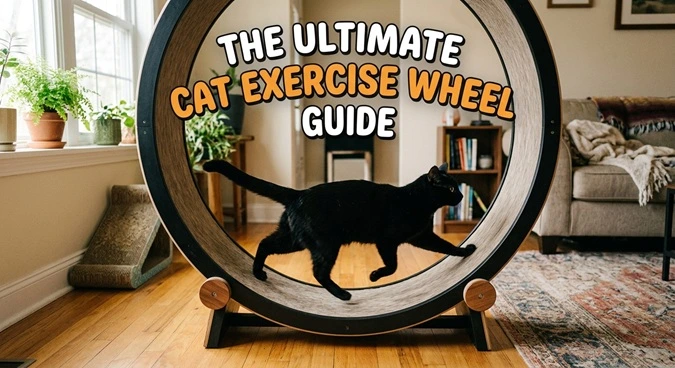




Cats that live indoors don't get to patrol territory, chase off intruders, or hunt for their meal. All of that exercise just isn't available to them anymore. The tradeoff is a safer life, but it also means a lot of indoor cats are seriously under-exercised. It shows up as extra weight, restless nights, and sometimes destructive behavior born out of boredom. Cat exercise wheels for indoor cats are the perfect solution!
Yes, like a hamster wheel, just built cat-sized! This is one of the few products that actually gives an indoor cat a real outlet to run. Not every cat takes to one right away.
And there's a genuine range of wheels out there depending on your cat's size, your budget, and how much space you've got. Below, we'll walk through why a wheel helps, how to get a skeptical cat on one, and then our 9 favorite wheels.
Cat Exercise Wheels for Indoor Cats
Why an Exercise Wheel Actually Helps Your Cat
Obesity is the most common weight-related health issue vets see in cats, and indoor cats are especially prone to it. Without territory to patrol or prey to chase, a lot of the movement a cat would naturally get in a day simply disappears. A wheel gives that missing movement somewhere to go.
Regular wheel use is commonly linked to a handful of real benefits beyond just weight management:
- Better muscle tone and joint flexibility, which matters even more for older cats managing arthritis.
- General cardiovascular health, the same way regular movement helps in any species.
- Fewer destructive scratching sessions, since a lot of that behavior is really just excess energy looking for somewhere to go.
- Calmer nights, with fewer of those 2 a.m. "zoomies" that come from a cat who didn't get to burn energy during the day.
- Lower general anxiety, since a wheel gives your cat's stalk-chase-capture instincts a legitimate outlet they don't otherwise have indoors.
Two things worth knowing before you buy one. If your cat is a senior or has an existing health condition, check with your vet before starting wheel use — vigorous exercise can aggravate certain conditions. And if you have a flat-faced (brachycephalic) breed like a Persian or some Himalayans, a wheel may not be a good fit at all. Their airway structure often makes sustained running genuinely difficult, no matter which wheel you choose.
How to Train Your Cat to Use a Wheel
Almost no cat walks up to a brand-new wheel and hops right on. That's normal, not a sign you bought the wrong product. Most cats need a little time and the right approach to get comfortable. Here's a training process that shows up, in some form, across nearly every wheel on this list's own instructions:
- Introduce it unpowered first. Let your cat sniff around and investigate the wheel with zero pressure to actually get on it. A few of our picks below build this exact step into their own instructions — for example, some wheels ship with a locked, stationary setting specifically for this first stage.
- Build a positive association before asking for movement. Feed a meal near the wheel, or let your cat sit or lie on it while it's locked in place. The goal is just making the wheel feel like a normal part of the room, not a big scary new object.
- Lure, don't force. A wand toy, a laser pointer, or a trail of treats just inside the running track is the most consistently effective way to get your cat's first few steps onto the surface.
- Keep early sessions short, and end on a win. Several short sessions beat one long one, especially in the first week or two. Reward any voluntary interaction with the wheel, not just full-on running.
- Expect a real range of timelines. Some cats are running within days. Others take weeks of calm, low-pressure exposure before they'll commit. Both outcomes are completely normal.
- Never force your cat onto a moving wheel, and supervise the first several sessions, especially with kittens or with a wheel that doesn't have a locking or brake mechanism.
- Try catnip or silvervine on the running surface as an extra nudge. A lot of owners sprinkle it directly onto the carpet runway before a cat's very first exposure to speed things along.
If your cat genuinely never takes to a wheel, that's fine too — not every cat wants to run in circles, and that's worth knowing before you commit. Our guides to the best cat activity centers and best cat laser toys both cover other ways to get an indoor cat moving that might click better for a cat who never warms up to a wheel.
Our Picks: 9 Cat Exercise Wheels Worth Buying in 2026
We looked at wheels across the full range of the market — from budget-friendly metal frames to premium birch-wood builds — in sizes running from compact (best for kittens and smaller cats) up to extra-large wheels built for bigger breeds.
Every product below is grouped by budget tier, so start with whichever section fits what you're looking to spend, then narrow down by size and features from there.
Best Overall Cat Exercise Wheel
Star Cat Wheel, 41.7" L
If you want the wheel with the fewest tradeoffs, this is it. It carries the strongest cross-review sentiment of anything in this roundup, and its 176 lb weight capacity is by far the highest of any wheel we looked at, so it's built to handle even a large cat with plenty of capacity to spare.
This is our top premium pick for cat exercise wheels. The quality and standout chase mechanism described below make a real case for choosing it.
The Easiest Setup
One Fast Cat Exercise Wheel, Gen. 7, 48"
If assembly dread is what's kept you from buying a wheel until now, this is the one to look at first. It's built from lightweight, snap-together ABS parts specifically designed to go together fast, and it's made in-house in Camarillo, California.
It's a genuinely solid pick for anyone who wants a large-diameter wheel without committing an entire weekend to putting it together.
Best for Large & Wide-Bodied Cats
Nordic Beast 48" XL Cat Wheel
At 15.7" wide, this has the widest running track of any wheel on this list — wide enough for two cats to share at once.
It's a favorite specifically among owners of larger breeds, and several Maine Coon and Savannah owners in particular call it well worth the money for a bigger cat that needed more room than a standard wheel offers.
Best for Multi-Cat Households
Homegroove Cat Exercise Wheel, 46" XL
This is the highest weight capacity of any pure wheel-only pick on this list, at 110 lbs, which makes it a smart choice if you've got multiple cats who'll be taking turns on it. It's also one of the best-reviewed options in this whole roundup, with a large base of owners backing it up.
Clearest Assembly Instructions
Naviconvex Cat Wheel, 46" XL
Assembly complaints are a running theme across this whole category, which is exactly what makes this pick stand out. Several reviewers specifically praise how clear the instructions and included assembly videos are, a genuine rarity in this space.
Best for Kittens & Small Cats
JubiNatural 35.9" Cat Exercise Wheel with Lock
This is the most compact wheel on our list, built specifically with kittens and small-to-medium cats in mind. If you've been holding off on a wheel because everything else on the market looked oversized for your cat, this is the one to start with.
Best Space-Saving All-in-One
5-in-1 Cat Wheel (CYlively), 41.3"
If you want one piece of furniture to cover exercise, rest, play, and feeding instead of buying separate items, this is the pick.
It's less a pure exercise wheel and more a small cat tree with a wheel built into it, which makes it a genuinely space-efficient option for a smaller home.
The Budget Cat Exercise Wheels Pick
GTPLAYER Cat Wheel, 40" Diameter, Metal
This is our budget-friendly pick, and it's also the only metal-frame build in the whole roundup — a real alternative if you're wary of wood warping or plastic cracking over time.
It's a smart starting point if you're not sure your cat will take to a wheel and want to test the waters first.
Best Value Wood Wheel
VEVOR Cat Exercise Wheel, 48" Wooden
If you want the look and feel of a premium wood wheel in a budget-friendly pick, this is a strong match. It's the largest wheel in the budget tier at 48" outer diameter, and it comes with a complete accessory kit to get you started right out of the box.
Additional Information
Frequently Asked Questions About Cat Exercise Wheels
For most healthy adult cats, yes. The main safety considerations are ones you should check before you buy: talk to your vet first if your cat is a senior or has an existing health condition, since vigorous exercise can aggravate some conditions.
Flat-faced breeds like Persians and some Himalayans often aren't good wheel candidates either, since their airway structure can make sustained running genuinely difficult.
Beyond that, supervise the first several sessions (especially with kittens), never force a cat onto a moving wheel, and consider a model with a locking or brake mechanism if you want an easy way to keep the wheel stationary when you're not around to watch.
It varies quite a bit by product, and it's one of the most inconsistent things reviewers report across this entire category — the same wheel can get reviews calling it nearly silent from one owner, and reviews calling it too loud from another, depending on the individual unit, the floor surface, and how the cat runs.
As a general pattern, metal-frame wheels and models with TPE (rubberized) rollers tend to run quieter, and nearly every wheel runs louder on hardwood or tile than on carpet. If nighttime noise is a dealbreaker, look for a pick above that specifically calls out quiet-running feedback, and consider placing a rug or mat underneath the wheel regardless of which one you choose.
Yes, with the right wheel. Look for a wider running track and a higher weight rating if more than one cat in your house is likely to use it.
The Nordic Beast and Homegroove picks above both stand out here — Nordic Beast has the widest track in this roundup at 15.7", wide enough for two cats side by side, and Homegroove carries the highest weight capacity of any pure wheel we looked at, at 110 lbs.
Match the wheel's inner diameter and weight rating to your cat's actual size, not just the marketed size name — a few "XL" wheels in this category measure noticeably smaller in practice than their name suggests, which we've flagged above where it came up.
As a general guide, compact wheels (under 40") suit kittens and small-to-medium cats best, while wheels in the 46"-48" range give larger or wider-bodied cats, like Maine Coons, enough room to fully extend while running.
That's genuinely normal, not a sign you bought the wrong product. Some cats take to a wheel within days; others take several weeks of calm, low-pressure exposure before they'll even step on it.
Go back through the training steps above: let your cat investigate the wheel unpowered first, build a positive association with treats or meals nearby, and lure with a wand toy rather than pushing or forcing. Catnip or silvervine sprinkled on the running surface can help too.
If your cat still isn't interested after consistent, patient effort, that's a real possibility worth accepting — not every cat wants to run in circles, and our guides to best cat activity centers and best cat laser toys are great alternatives for you to consider!
No. Every wheel on this list, and cat exercise wheels in general, run entirely on your cat's own motion — there's no motor, battery, or power cord involved. Your cat provides all the movement; the wheel just spins freely (or locks in place, on models with that feature) in response.
Most kittens can start once they're fully weaned, steady on their feet, and cleared by your vet for normal activity, though a very young or small kitten may do better starting on a compact wheel sized for smaller cats rather than a full-size 46"-48" model.
The JubiNatural pick above, at a 33.9" inner diameter, is specifically built with kittens and small cats in mind, and the same training process outlined earlier in this guide applies at any age — just keep first sessions extra short and closely supervised with a young kitten.
Wrapping it Up on Cat Exercise Wheels
A wheel isn't a guaranteed fix for every under-exercised indoor cat, but for a lot of cats it's the single best outlet you can give them for real, sustained running.
Start with the training steps above, pick a wheel sized right for your cat, and give it time — a cautious cat coming around slowly is normal, not a sign the wheel was the wrong choice.
Which cat exercise wheel do you use? Do you have a favorite or a recommendation that I didn’t include in my list ? If you have any other ideas for please leave a comment below or send me an email at Craig@StuffCatsWant.com so I can update this article.